SIDRA Institute

Policy Briefs

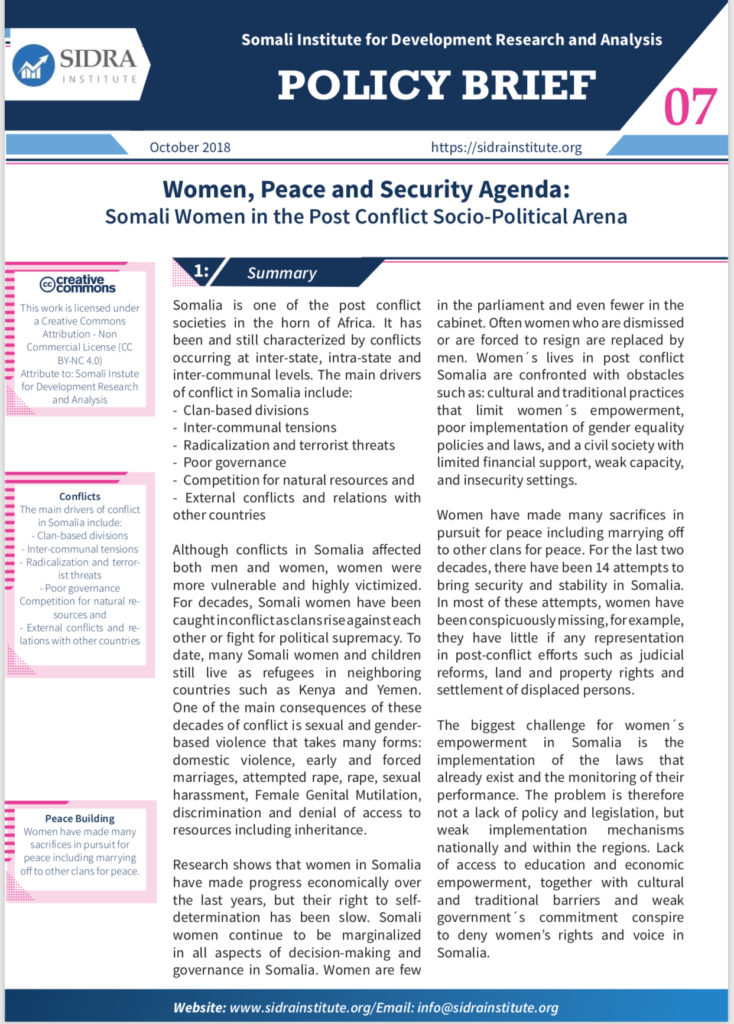
Women, Peace and Security Agenda: Somali Women in the Post Conflict Socio-Political Arena

Between March and June (2018) SIDRA Institute, in partnership with the Swedish organization Kvinna till Kvinna, undertook a study that gathered up to date data regarding women, peace and security in Somalia. The study -which main results are summarized in this Policy Brief- developed a series of data collection tools and methodology to collect information from secondary sources (i.e. literature review) and primary data (using qualitative methods). The study was informed by the review of policy and legislative documents of the governments, international and local development partners and other key stakeholders. Primary information was collected through focus groups discussions and key informant interviews in five cities in Somalia (Garowe, Mogadishu, Hargeisa, Adado and Galkacyo) and from other stakeholders in Nairobi.

Women, Peace and Security Agenda: Somali Women in the Post Conflict Socio-Political Arena Read More »

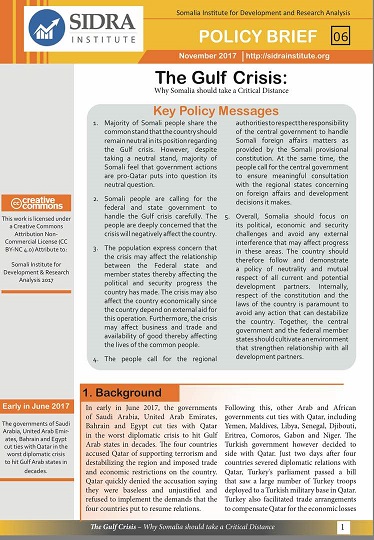
The Gulf Crisis: Why Somalia should take a Critical Distance

To better understand the position the Somali government should take regarding the Gulf crisis, the Somalia Institute for Development and Research Analysis (SIDRA) carried out a policy briefing study in five of the major cities of Somalia (Mogadishu, Kismayo, Baidoa, Garowe and Adado). The study collected data through public surveys and key informant Interviews. For the public interview, 166 respondents were engaged in each city and a total of 830 respondents completed the study questionnaire. 50 key informant interviews were conducted in the five cities.

The Gulf Crisis: Why Somalia should take a Critical Distance Read More »

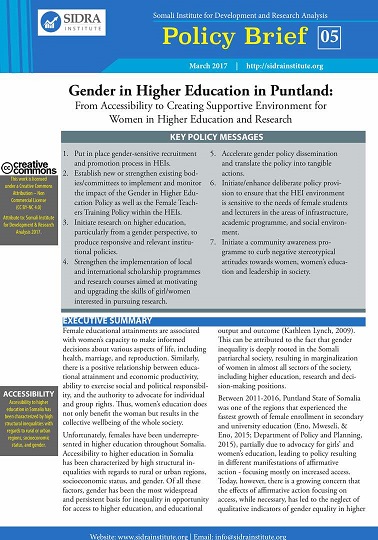
Gender in Higher Education in Puntland: From Accessibility to Creating Supportive Environment for Women in Higher Education and Research

Female educational attainments are associated with women’s capacity to make informed decisions about various aspects of life, including health, marriage, and reproduction. To discuss the challenges and opportunities facing women in higher education and possible solutions, SIDRA arranged a knowledge exchange conference to discuss ‘gender in higher education in Puntland, Somalia on 21-23 November, 2016. This policy brief is based primarily on the output of the conference.

Gender in Higher Education in Puntland: From Accessibility to Creating Supportive Environment for Women in Higher Education and Research Read More »

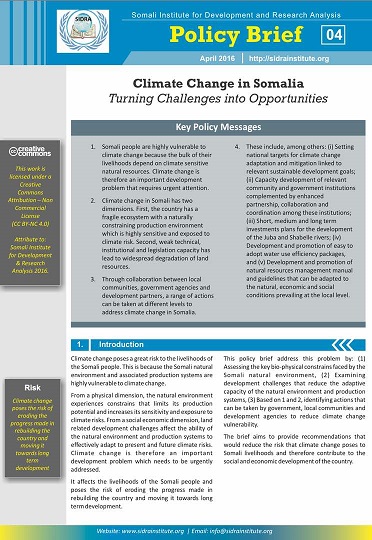
Climate Change in Somalia: Turning Challenges into Opportunities

Climate change poses a great risk to the livelihoods of the Somali people. This is because the Somali natural environment and associated production systems are highly vulnerable to climate change. This policy brief address this problem by: (1) Assessing the key bio-physical constrains faced by the Somali natural environment, (2) Examining development challenges that reduce the adaptive capacity of the natural environment and production systems, (3) Based on 1 and 2, identifying actions that can be taken by government, local communities and development agencies to reduce climate change vulnerability.

Climate Change in Somalia: Turning Challenges into Opportunities Read More »

Policy Brief: Sustainable Development Goals for Somalia: Policy Imperatives of Localization

Experience in the pursuit of the Millennium Development Goals has brought out the limitations of the top down approach. There is an urgent need for localizing its successor programme, the Sustainable Development Goals. such an approach in Somalia would call for both structural and institutional changes in order to facilitate citizen participation in defining and implementing the SDGs. This policy brief sets out a preliminary agenda for the same.

Policy Brief: Sustainable Development Goals for Somalia: Policy Imperatives of Localization Read More »

Policy Brief: Democracy in Puntland: The People’s Choice

The process of constitutionalizing democratic elections in Puntland began in 2008 under President Adde Muse’s through a draft constitution which was later adopted following a constituent assembly vote during President Farole’s administration. The draft constitution received an overwhelming acceptance in 2012 with 472 votes from 480 delegates. This resulted in the introduction of a multi-party system for the first time in Puntland’s history. The government enacted the new electoral law that culminated in the establishment of Transitional Puntland Electoral Commission. The first democratic local council elections were then slated for July 2013 but just a day before the polls, there was violence in Qardho and Galkayo towns leaving at least three people dead and resulting in the indefinite postponement of the elections, which were to be the first democratic election in Puntland since 1969. It is against this backdrop that this paper seeks to explore the perception and expectations of the citizens in Puntland towards this democratization process. Further, it seeks to identify the fundamental issues that need to be addressed prior to the commencement of this process and to provide a basis for public dialogue, which will ensure an evidence-based policy making process.

Policy Brief: Democracy in Puntland: The People’s Choice Read More »

Policy Brief: Somalia 2016 Elections: Contesting the Boundaries of Democracy

At the end of 2013, the Federal Government of Somalia (FGS) committed to “Vision 2016”, an audacious plan to execute all the points of reference in the Provisional Constitution of Somalia and the New Deal’s Somali Compact. These two crucial documents directed the FGS to undertake various legal and institutional functions within a specific time frame. These guidelines facilitated the formulation of Vision 2016, which authorized the government to groom the nation for direct elections in 2016. Vision 2016 capitalizes on election as an inexorable means of initiating a fresh, post-conflict civic order in Somalia where citizens are mandated to select their representatives and hence bestow legality in the new political order. However, the light of this vision was dimmed in July 2015 when the Federal government leaders informed the nation that it will not be possible to hold direct “one-person one-vote” elections in 2016. Consequently, the government, in consultation with other local and regional constituents, has designed an action plan and legal framework for 2016 election. On 29th and 30th July 2015, the high level Partnership Forum held in Mogadishu endorsed this action plan, based on guiding principles, which elaborates the plan to develop an outline for a National Consultative Process to determine the most appropriate model for 2016 election. In September 2015, in Mogadishu, the Federal Government, Federal Member States, Civil Society and International Community witnessed the formation of a National Consultative Forum on Electoral Processes (NCFEP). NCFEP was commissioned to engage the civil society and lobby for recommendations on best models for 2016 electoral process. Within this context, this Policy Brief is based on the results of a study addressing;(a) People’s perception towards “Vision 2016”, (b) The alternatives menu of options available to the original direct election “one-man one -vote” plan, and (c) The possibility of holding elections in 2016.

Policy Brief: Somalia 2016 Elections: Contesting the Boundaries of Democracy Read More »

Scroll to Top