SIDRA Institute

Policy Briefs

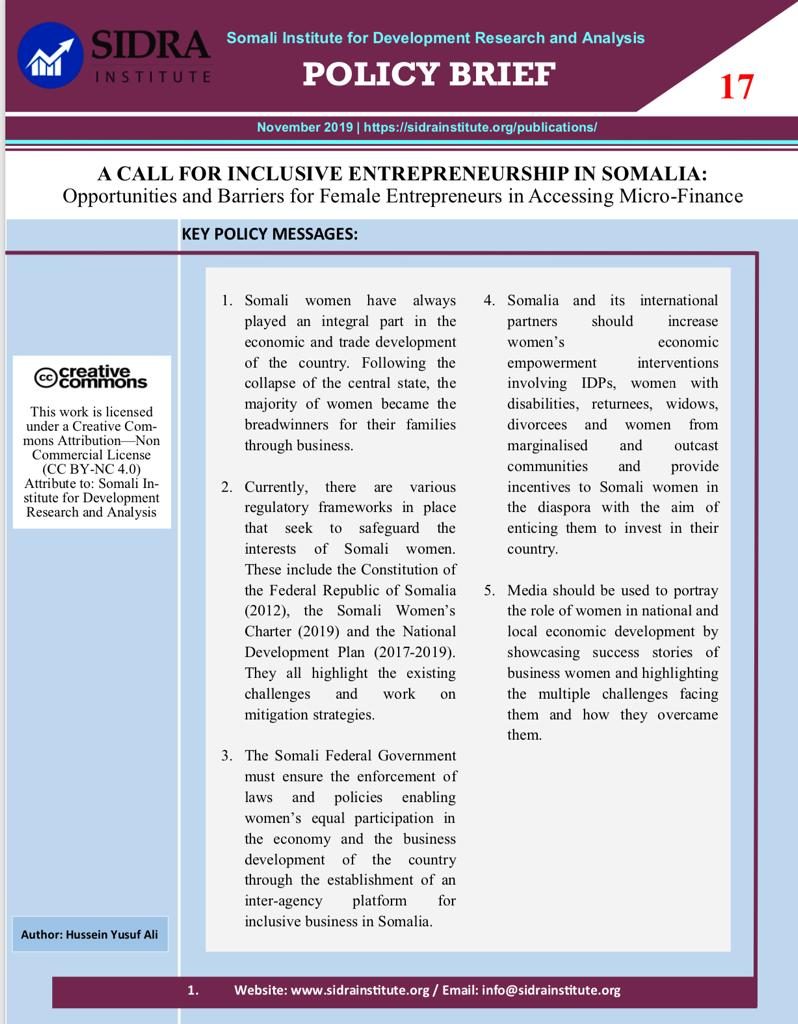
A Call for Inclusive Entrepreneurship in Somalia

Somali women have always played an integral part in the economic and trade development of the country. Following the collapse of the central state, the majority of women became the breadwinners for their families through business. The Somali Federal Government must ensure the enforcement of laws and policies enabling women’s equal participation in the economy and the business development of the country through the establishment of an inter-agency platform for inclusive business in Somalia.

A Call for Inclusive Entrepreneurship in Somalia Read More »

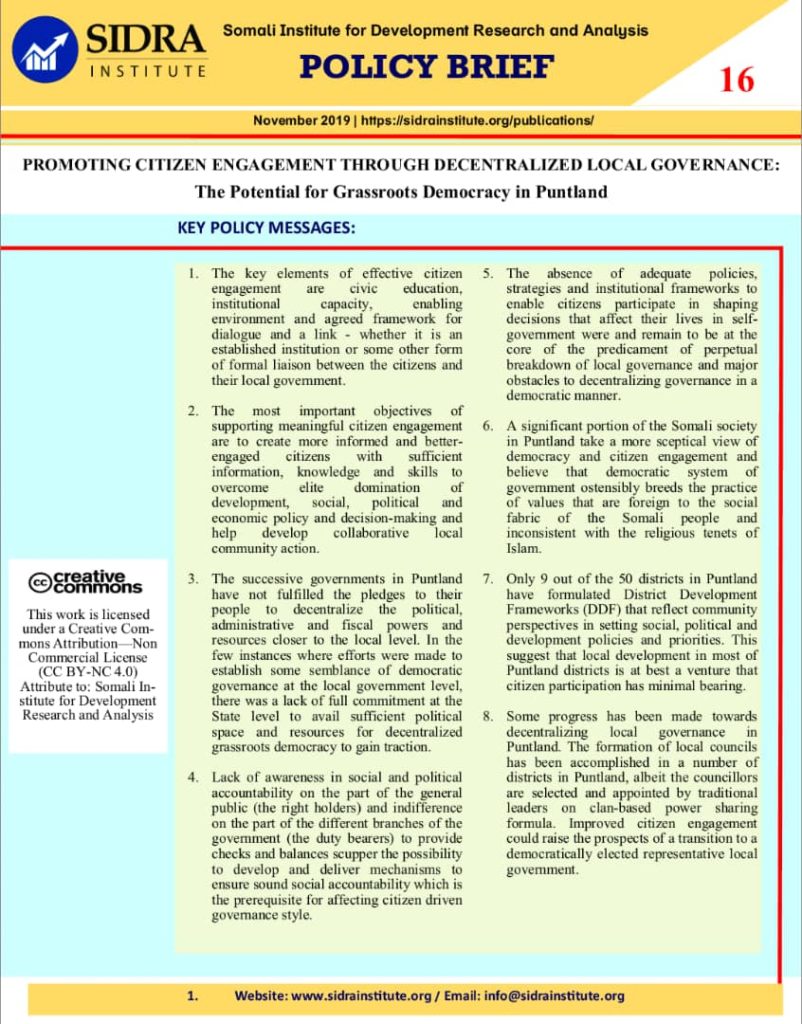
Promoting Citizen Engagement Through Decentralized Local Governance: The Potential for Grassroots Democracy in Puntland

The key elements of effective citizen engagement are civic education, institutional capacity, enabling environment and agreed framework for dialogue and a link – whether it is an established institution or some other form of formal liaison between the citizens and their local government. SIDRA conducted this study to seek understanding of the level of citizen engagement in Puntland local governance and the intertwined role and effects of decentralization, democratization and citizen engagement.

Promoting Citizen Engagement Through Decentralized Local Governance: The Potential for Grassroots Democracy in Puntland Read More »

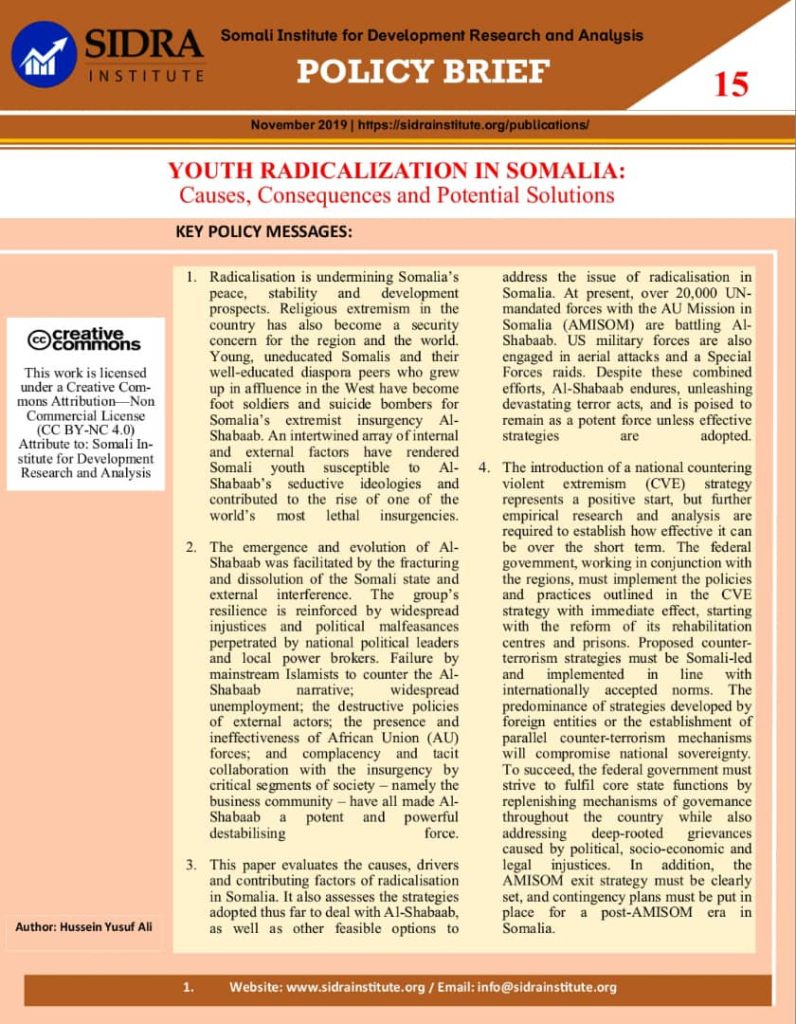
Youth Radicalization in Somalia

Radicalisation is undermining Somalia’s peace, stability and development prospects. Religious extremism in the country has also become a security concern for the region and the world. Young, uneducated Somalis and their well-educated diaspora peers who grew up in affluence in the West have become foot soldiers and suicide bombers for Somalia’s extremist insurgency Al- Shabaab. This paper is informed by qualitative research in the form of interviews with key informants. In addition, desk research was conducted to complement the primary sources. In each of the seven major Somali cities, 10 key informant interviews and a single focus group discussion were conducted, producing a total data set comprising 70 individual interviews and seven focus group discussions. All respondents were asked to discuss the root causes of youth radicalisation in Somalia and suggest potential solutions.

Youth Radicalization in Somalia Read More »

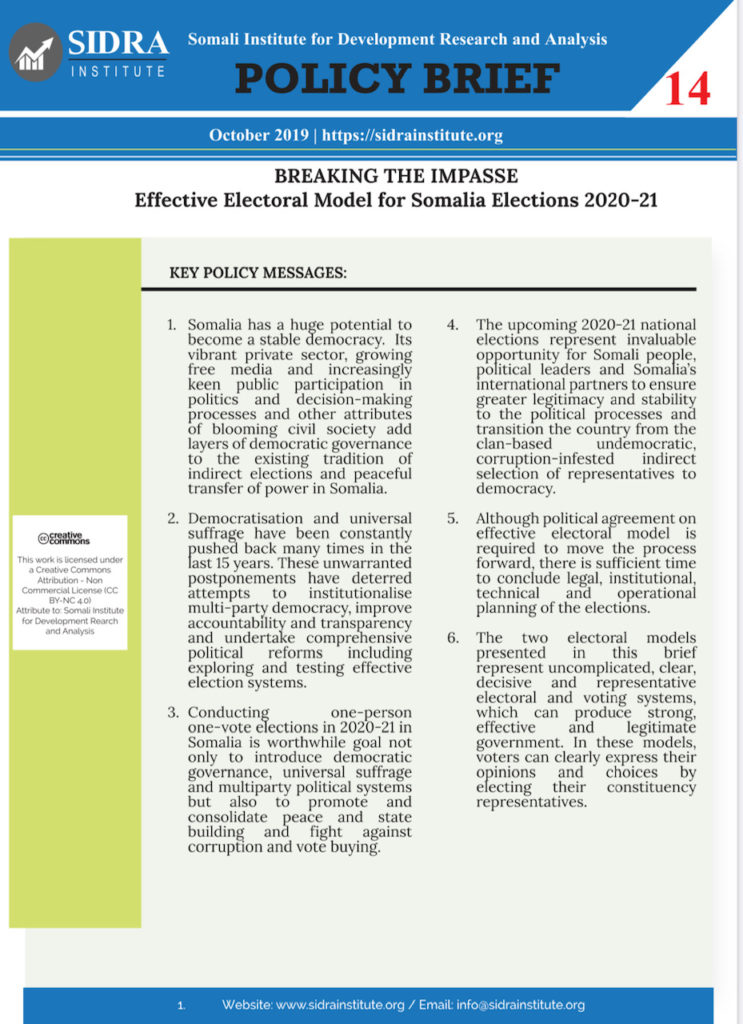
Breaking the Impasse: Effective Electoral Model for Somalia Elections 2020-21

Somalia is slowly emerging from decades of state failure, fragility and protracted fight against the insurgency Islamist Alshabaab. A fixed term parliament, a flourishing tradition of indirect elections and peaceful transfer of power in every four years have prevailed in the country for the last 15 years. Despite the successive peaceful change of governments, progress towards institutionalising this emerging democracy and establishing viable electoral system has been very slow mainly due to lack of political commitment and agreement between the factious political leaders of the Federal Government of Somalia (FGS) and the Federal Member States (FMS) compounded by security, institutional and technical constraints.

Breaking the Impasse: Effective Electoral Model for Somalia Elections 2020-21 Read More »

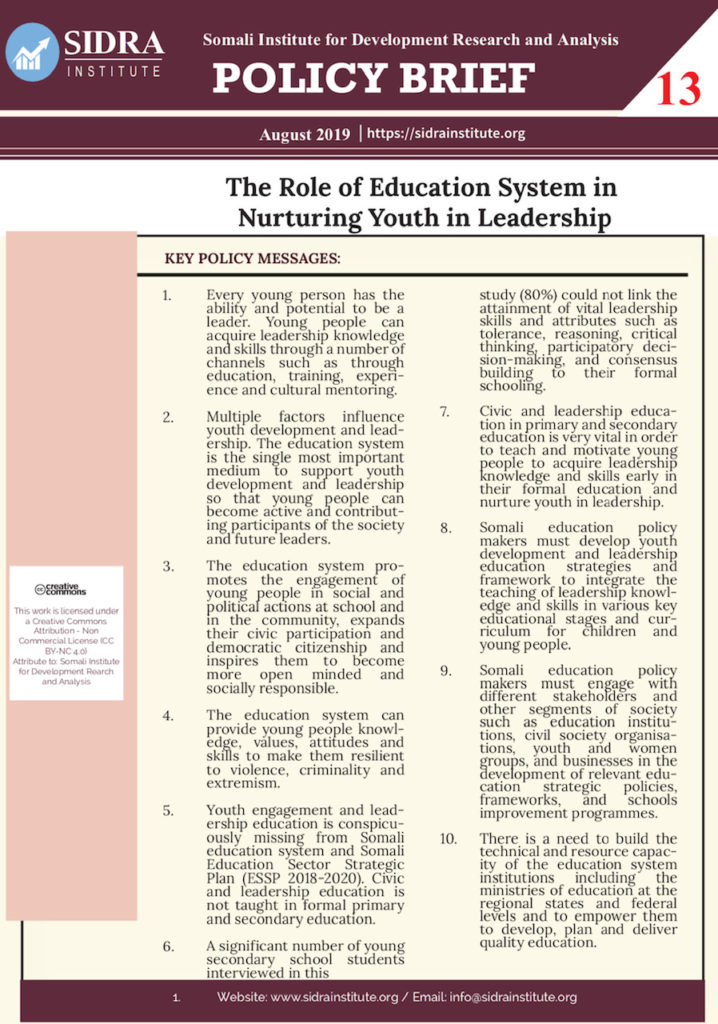
The Role of Education System in Nurturing Youth in Leadership

SIDRA has conducted a short study on “the role of the education system in nurturing youth in leadership”. The study sought to highlight how the education system shapes the attitudes, knowledge, skills and competences of young people in leadership and examined the understanding of students in secondary education about leadership skills and characteristics. The policy brief reports the absence of youth leadership education in Somali education system and calls for discussion and debate on education reform to promote youth leadership in primary and secondary education. It presents practical recommendations for the development and integration of youth leadership education and leadership opportunities for young people in Somali education system.

The Role of Education System in Nurturing Youth in Leadership Read More »

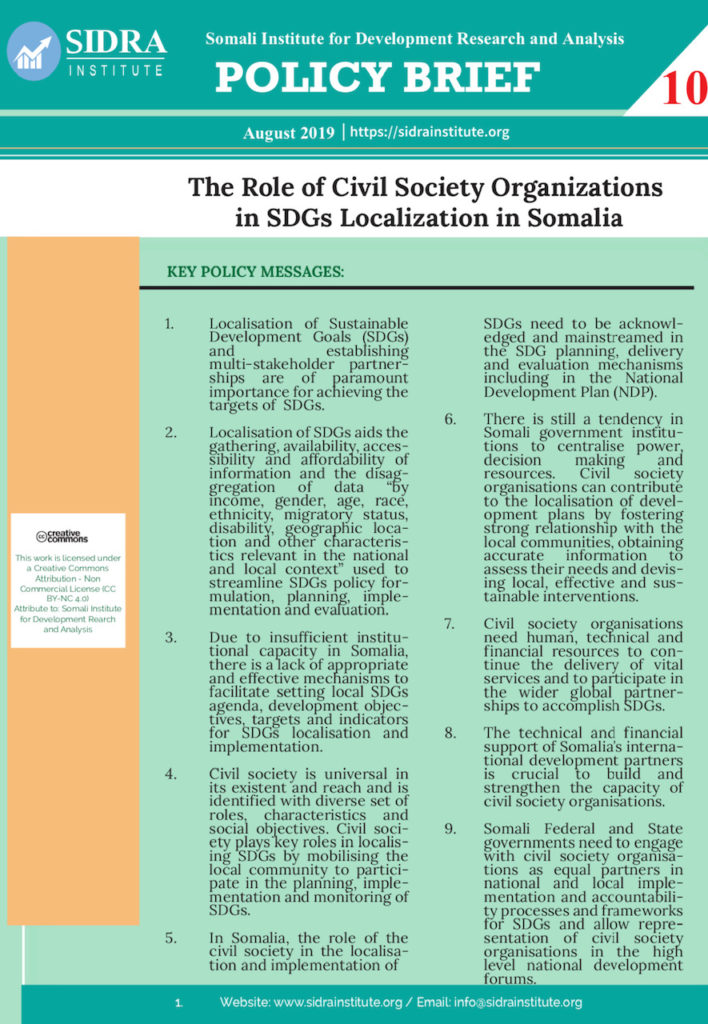
The Role of Civil Society Organizations in SDGs Localization in Somalia

The urgent call of action to implement the SDGs demand the development of strategies and plans to help translate the goals into sustainable, affordable and effective development objectives and measurable outcomes at the national and local levels. While national governments focus on setting national agenda and establishing global partnerships to achieve SDGs, it is the local authorities, businesses and the civil society that play the most critical roles to localise and implement the SDGs. This policy document outlines the crucial role of civil society in the efforts to localise and implement SDGs and provides practical recommendations to promote their active and greater participation in all phases of SDGs.

The Role of Civil Society Organizations in SDGs Localization in Somalia Read More »

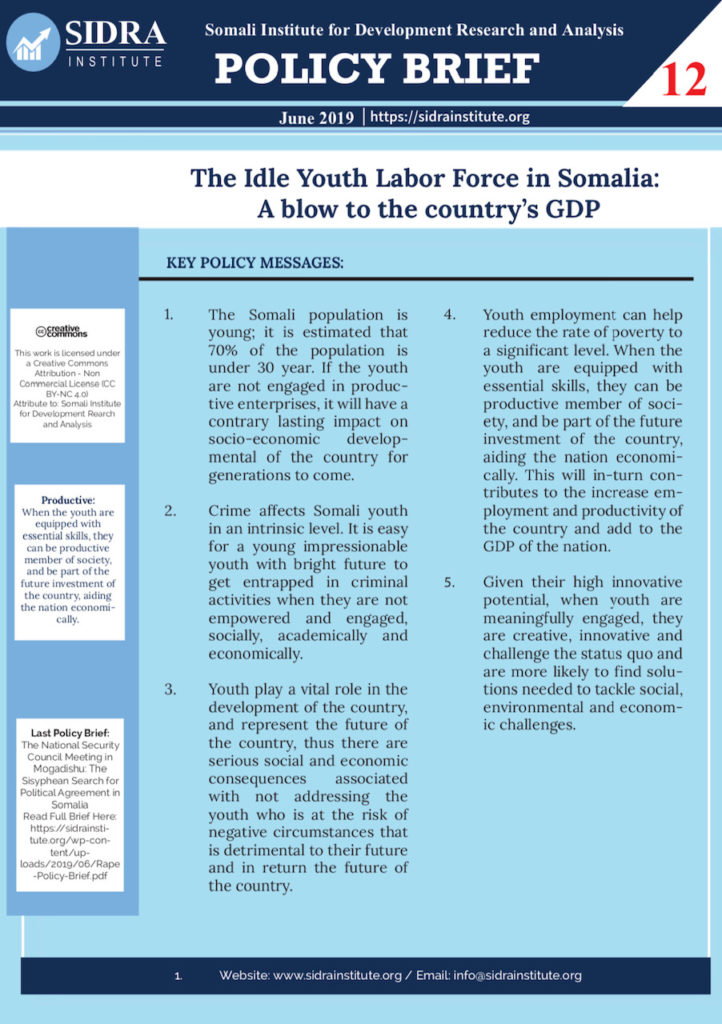
The Idle Youth Labor Force in Somalia: A blow to the Country’s GDP

An idle youth with chronic unemployment is a ticking bomb and a danger to the nation as they are attracted to join dangerous groups to do harm, terrorist and violence acts. These dangerous groups exploit the youth to utilize them as means to kill, maim, rob and rape, and thus destroy the future of the next generation. If given the right opportunity, Somali youth have the potential to reinvigorate and become the saving grace of the nation. Reeling from a battered self-defeat of war and its aftermath as a country embarking on restoring Somali youth to become productive citizens should be given a priority. There is the potential to inspire the Somali youth to pursue education, employment and creative means to contribute peace and security as well as the development of the country.

The Idle Youth Labor Force in Somalia: A blow to the Country’s GDP Read More »

Rape: A Rising Crisis and Reality for the Women in Somalia

This policy paper will examine rape culture in the context of traditional norms, historic nature of rape, rape as a weapon of war and the manner in which rape has climaxed in recent years. The aim is to analyze and dissect how powerlessness, inequality, entrenched cultural perception of gender and women’s place in society and the breakdown of social norms due to the Somali state failure are contributing to the increase in the incidences of sexual violence against Somali women, leading to horrific cases of rape on Somali women and girls. The policy brief will inform the impact of intersectionality of patriarchy, objectification, gender stereotypes, and normalized rape culture all precipitating the onset of rape and subsequent lack of reporting and criminalization.

Rape: A Rising Crisis and Reality for the Women in Somalia Read More »

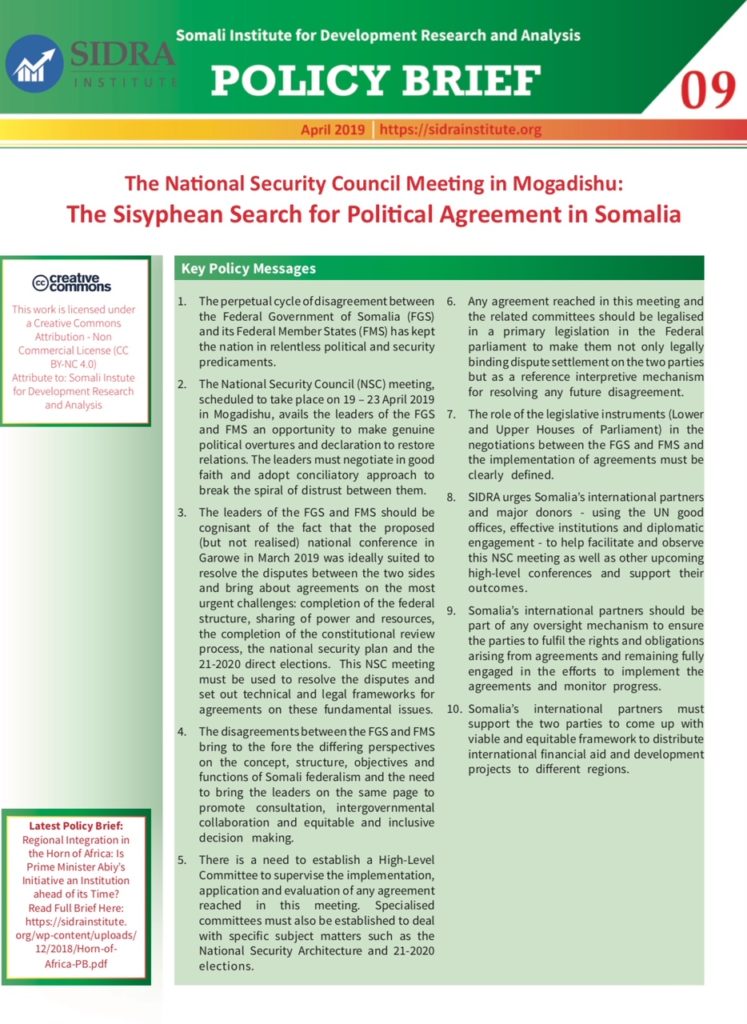
The National Security Council Meeting in Mogadishu: The Sisyphean Search for Political Agreement in Somalia

On 5 April 2019 the President of the Federal government, Mr Mohamed Abdullahi Farmaajo, has called for a meeting of the National Security Council, inviting the presidents of the Federal Member States to Mogadishu on 19 – 23 April 2019. Notwithstanding the suggestions that this NSC meeting is convened at the behest of Somalia’s international partners ahead of a crucial meeting to review Somalia Transition Plan for Security late April 2019, there is a concern that it may have been organised to shelf the Garowe conference.

The National Security Council Meeting in Mogadishu: The Sisyphean Search for Political Agreement in Somalia Read More »

Regional Integration in the Horn of Africa: Is Prime Minister Abiy’s Initiative an Institution ahead of its Time?

The Horn of Africa (HoA) region has been riddled with inter-state armed conflict, poverty, drought, extremism and famine. Dictatorships and authoritarian regimes have ruled much of the region and contributed to the broken political and social system in the region. Decades of underdevelopment coupled with social disparity and divisions along ethnic, religious, tribal, cultural and political lines have contributed to the conflicts and social upheavals within the region. The Horn of Africa had not smelt any signs of integration until of recent in April 2018 when Mr.Abiy Ahmed was named Prime Minister of Ethiopia. It would be overly simplistic to attribute the concept of horn of Africa regional integration only to the inspiration of Mr Abiy Ahmed. For some time, this idea of regional integration was floated in a number of local and international forums as the springboard to construct viable polity to improve security and trade in the region.

Regional Integration in the Horn of Africa: Is Prime Minister Abiy’s Initiative an Institution ahead of its Time? Read More »

Scroll to Top