Vacancy: Executive Director
Vacancy: Executive Director Read More »
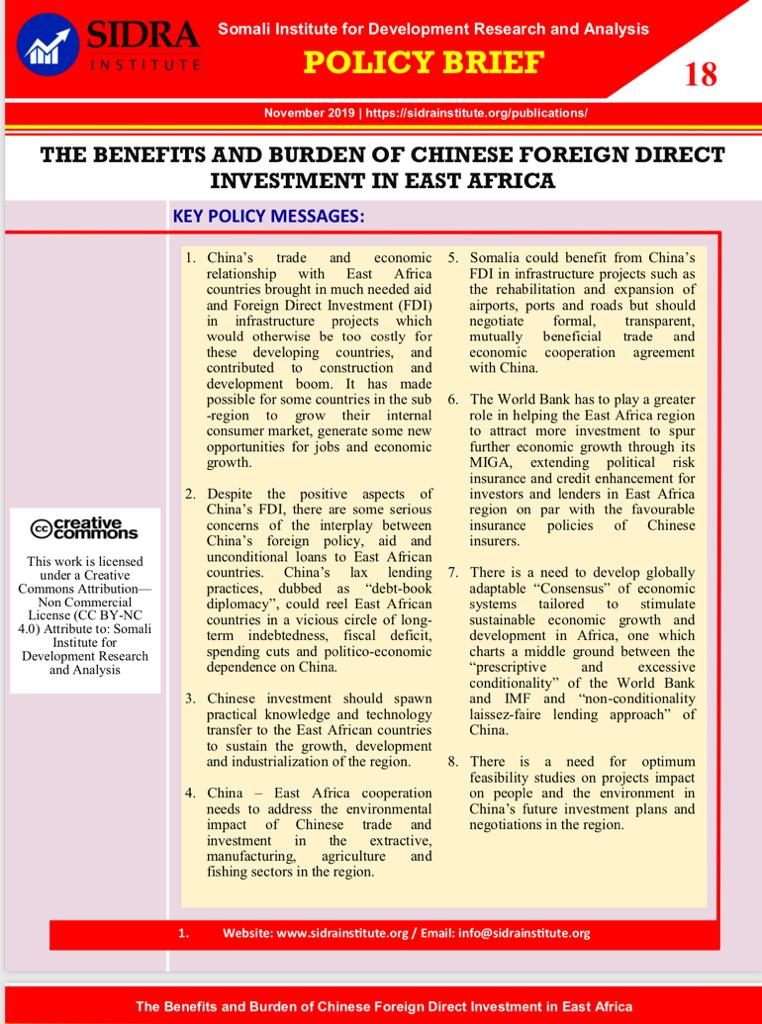
China’s trade and economic relationship with East Africa countries brought in much needed aid and Foreign Direct Investment (FDI) in infrastructure projects which would otherwise be too costly for these developing countries, and contributed to construction and development boom. It has made possible for some countries in the sub-region to grow their internal consumer market, generate some new opportunities for jobs and economic growth. Somalia could benefit from China’s FDI in infrastructure projects such as the rehabilitation and expansion of airports, ports and roads but should negotiate formal, transparent, mutually beneficial trade and economic cooperation agreement with China.
The Benefits and Burden of Chinese Foreign Direct Investment in East Africa Read More »
Somali women have always played an integral part in the economic and trade development of the country. Following the collapse of the central state, the majority of women became the breadwinners for their families through business. The Somali Federal Government must ensure the enforcement of laws and policies enabling women’s equal participation in the economy and the business development of the country through the establishment of an inter-agency platform for inclusive business in Somalia.
A Call for Inclusive Entrepreneurship in Somalia Read More »
The key elements of effective citizen engagement are civic education, institutional capacity, enabling environment and agreed framework for dialogue and a link – whether it is an established institution or some other form of formal liaison between the citizens and their local government. SIDRA conducted this study to seek understanding of the level of citizen engagement in Puntland local governance and the intertwined role and effects of decentralization, democratization and citizen engagement.
Radicalisation is undermining Somalia’s peace, stability and development prospects. Religious extremism in the country has also become a security concern for the region and the world. Young, uneducated Somalis and their well-educated diaspora peers who grew up in affluence in the West have become foot soldiers and suicide bombers for Somalia’s extremist insurgency Al- Shabaab. This paper is informed by qualitative research in the form of interviews with key informants. In addition, desk research was conducted to complement the primary sources. In each of the seven major Somali cities, 10 key informant interviews and a single focus group discussion were conducted, producing a total data set comprising 70 individual interviews and seven focus group discussions. All respondents were asked to discuss the root causes of youth radicalisation in Somalia and suggest potential solutions.
Youth Radicalization in Somalia Read More »
Somalia is slowly emerging from decades of state failure, fragility and protracted fight against the insurgency Islamist Alshabaab. A fixed term parliament, a flourishing tradition of indirect elections and peaceful transfer of power in every four years have prevailed in the country for the last 15 years. Despite the successive peaceful change of governments, progress towards institutionalising this emerging democracy and establishing viable electoral system has been very slow mainly due to lack of political commitment and agreement between the factious political leaders of the Federal Government of Somalia (FGS) and the Federal Member States (FMS) compounded by security, institutional and technical constraints.
Breaking the Impasse: Effective Electoral Model for Somalia Elections 2020-21 Read More »
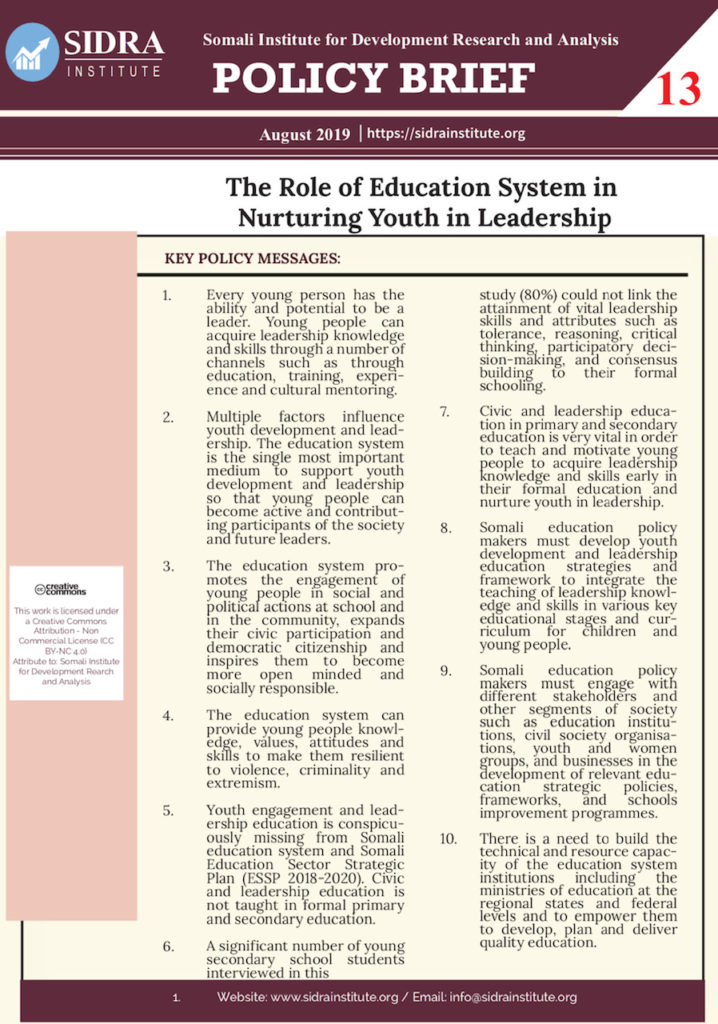
SIDRA has conducted a short study on “the role of the education system in nurturing youth in leadership”. The study sought to highlight how the education system shapes the attitudes, knowledge, skills and competences of young people in leadership and examined the understanding of students in secondary education about leadership skills and characteristics. The policy brief reports the absence of youth leadership education in Somali education system and calls for discussion and debate on education reform to promote youth leadership in primary and secondary education. It presents practical recommendations for the development and integration of youth leadership education and leadership opportunities for young people in Somali education system.
The Role of Education System in Nurturing Youth in Leadership Read More »
The urgent call of action to implement the SDGs demand the development of strategies and plans to help translate the goals into sustainable, affordable and effective development objectives and measurable outcomes at the national and local levels. While national governments focus on setting national agenda and establishing global partnerships to achieve SDGs, it is the local authorities, businesses and the civil society that play the most critical roles to localise and implement the SDGs. This policy document outlines the crucial role of civil society in the efforts to localise and implement SDGs and provides practical recommendations to promote their active and greater participation in all phases of SDGs.
The Role of Civil Society Organizations in SDGs Localization in Somalia Read More »
The number of girls enrolled in primary and secondary education globally is higher than ever before, and yet in Somalia large numbers of girls still drop out of secondary schools as a result of discriminatory gender norms. The Somali Institute for Development Research and Analysis (SIDRA) conducted qualitative research – including a video and blogging project – to understand the social, cultural and economic barriers that affect access to higher education for girls and women in Puntland, Somalia in particular.
A vibrant civil society is essential to the sustenance of any nation’s development. In Puntland State of Somalia, the role of civil society groups has been vital in the political, social and economic development of the country. Civil society organizations (CSOs) have assisted in improving the life’s quality of the people of Puntland, ensuring good governance, developing the capacity of the government to apply the principles of accountability, transparency and openness; and working towards sustainable development of the region and state. The CSOs have also played an important role in delivering humanitarian assistance, while they fill the void created by the collapse of the government. The major objective of this study was to understand the current environment for civil society’s operations and to recommend actions for effective and coordinated work of CSOs in Puntland. Twenty three organizations in Galkacyo and Garowe cities participated in this study through in-depth interviews on issues of structure, functionality, goals and objectives to examine their challenges and strengths. The research sought to understand civil society’s creative power and collective action, while they attempt to stay sustainable and relevant to the needs of the citizens, who depend on their local CSO to solve their social problems.
The Enabling and Disenabling for CSO Operations in Somalia Read More »