SIDRA Institute

SIDRA

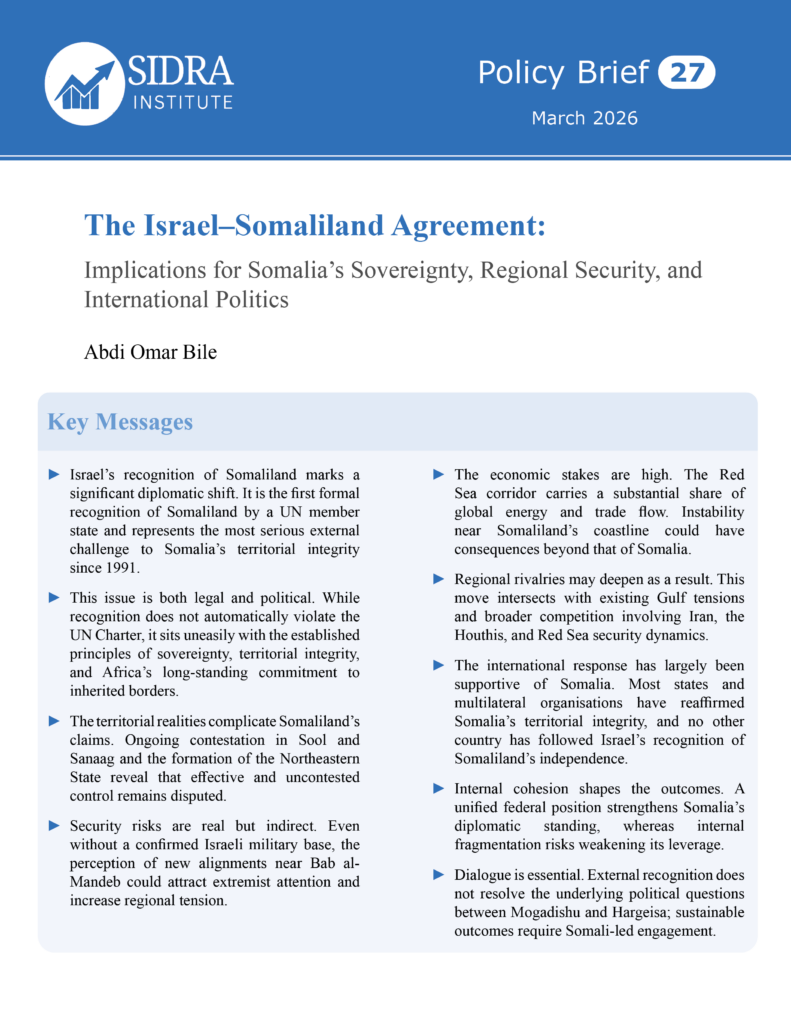
The Israel–Somaliland Agreement: Implications for Somalia’s Sovereignty, Regional Security, and International Politics

The collapse of the military government led by Mohamed Siad Barre in 1991 triggered state breakdown and civil war across Somalia. In the north, the Somali National Movement (SNM) consolidated control over most of the former British Somaliland Protectorate. Following a series of reconciliation conferences involving SNM leaders, clan elders, and community representatives, the SNM Central Committee declared on 18 May 1991 the restoration of the Republic of Somaliland within the borders of the former British Protectorate (Interpeace, 2008). Over the following decades, Somaliland reduced inter-clan conflict, established hybrid governance combining traditional elders (Guurti) with modern institutions, and held multiple elections. A 2001 referendum reportedly showed overwhelming support for independence. Despite maintaining relative internal stability and functioning institutions, Somaliland has not received international recognition and continues to be regarded under international law as part of the Federal Republic of Somalia (Michael Walls and Steve Kibble, 2011). Somaliland grounds its territorial claim in the borders of the former British Protectorate, which briefly gained independence on 26 June 1960 before uniting with Italian-administered Somalia on 1 July 1960. However, its claim over the Sool and Sanaag regions has long been contested. In August 2023, SSC-Khatumo forces took control of Las Anod and surrounding areas, and in October 2023 the Federal Government recognised SSC-Khatumo as an interim administration (Horseed Media, 2023). In July 2025, a Grand Constitutional Conference declared the formation of the Northeastern State as Somalia’s sixth Federal Member State, with federal recognition granted on 31 July 2025 (CHS Doha, 2025). These developments have altered the territorial realities underlying Somaliland’s independence claim. In recent years, Somaliland has intensified its diplomatic and lobbying efforts to secure international recognition. In early 2025, international media reported that the United States and Israel had approached several East African actors, including Somaliland, as possible destinations for resettling Palestinians displaced from Gaza under proposals linked to the U.S. President Donald Trump’s post-war plan (AP, 2025). Reports also suggest that the United Arab Emirates, which normalized relations with Israel under the Abraham Accords, may have played a facilitating role. The UAE maintains strong economic ties with Somaliland, including a $442 million investment in the development and operation of the Berbera port (Bloomberg, 2026). Somaliland’s location along the Gulf of Aden, near the Bab al-Mandeb Strait and the sea route connecting the Red Sea to the Suez Canal, significantly enhances its geopolitical importance. This corridor carries a substantial share of global container traffic and energy shipments (World Bank, 2025). Its strategic position has attracted sustained interest from regional and international actors. In January 2024, Ethiopia and Somaliland signed a Memorandum of Understanding under which Ethiopia would gain access to the Red Sea through Berbera in exchange for potentially recognising Somaliland as an independent state (BBC, 2024). Although the agreement was not formalised, it intensified regional tensions. On 26 December 2025, Israel formally recognised Somaliland as an independent state under the framework of the Abraham Accords (BBC, 2025). Somalia’s Federal Government strongly condemned the decision, describing it as a violation of its sovereignty and warning against any foreign military presence on its territory (AlJazeera, 2025). This recognition marked the first time a UN member state formally acknowledged Somaliland’s independence, transforming a long-standing political dispute into a major international diplomatic and security concern. Against this backdrop, this policy brief analyses the political, legal, security, and diplomatic implications of Israel’s recognition of Somaliland for Somalia and the wider Horn of Africa. This study examines how this decision may affect Somalia’s sovereignty, regional stability, and international relations. This brief aims to inform policymakers, regional actors, and international partners about the associated risks and support evidence-based responses that uphold Somalia’s unity, constitutional order, and long-term stability.

The Israel–Somaliland Agreement: Implications for Somalia’s Sovereignty, Regional Security, and International Politics Read More »

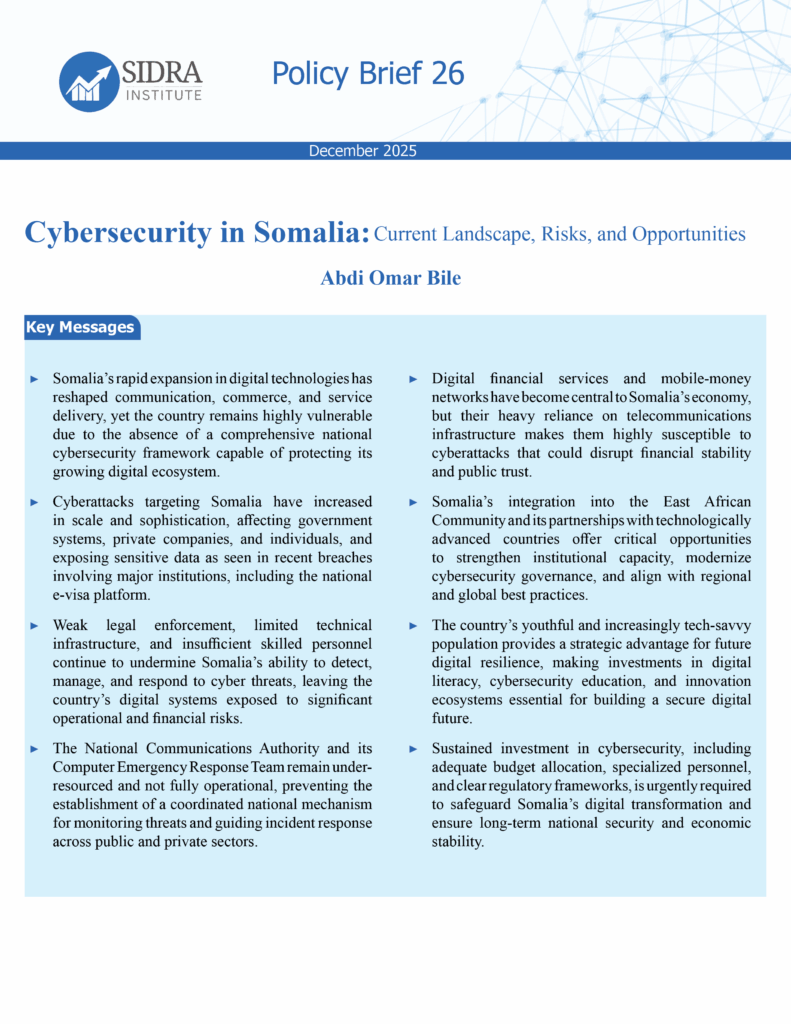
Cybersecurity in Somalia: Current Landscape, Risks, and Opportunities

Digital technologies and internet connectivity continue to reshape social and economic systems worldwide. For households, improved access to timely information and reduced transaction costs help strengthen learning outcomes, support more active labor-market participation, and raise income and overall welfare. For businesses, digital tools are becoming integral to decision-making, operational efficiency, innovation, and the ability to reach a broader market (World Bank, 2024). Africa is experiencing a rapid digital transformation. Despite ongoing challenges related to infrastructure, connectivity, and service reliability, Internet adoption continues to rise across the continent. Between 2019 and 2022, more than 160 million people became regular users of cyberspace, highlighting the growing dependence on digital platforms for communication, commerce, education, and governance (World Bank, 2024). This expansion is reshaping how communities connect and access opportunities, even as digital inclusion remains uneven across regions. Despite the rapid expansion of the digital age, this transformation has also introduced significant risks, most notably the rising threat of cybercrime. As technological innovation accelerates, cybercriminals have adapted in parallel, using increasingly sophisticated methods to exploit digital vulnerabilities. These developments pose serious risks to individuals, organizations, and national security. The impacts extend well beyond financial losses, often resulting in considerable psychological and emotional distress for victims (Interpol, 2024). In 2024, the cybersecurity landscape was shaped by rising geopolitical tensions, rapid AI adoption, and increasing vulnerabilities across global supply chains, according to the Global Cybersecurity Outlook 2025 (World Economic Forum, 2025). Organizations faced mounting pressure as regulatory environments became more fragmented and cybercrime, particularly AI enhanced ransomware, grew more sophisticated. More than 15 million cybercrime incidents were recorded globally in 2024, a slight decrease from the previous year. The highest level was in 2021, with 19.23 million incidents (Statista, 2025). In 2023, nearly 10 million devices were infected with data-stealing malware, each exposing an average of 51 login credentials. Cybercriminals used these stolen credentials to enable further attacks or traded them across dark-web forums and private Telegram channels (Kaspersky, 2024). Africa is among the regions that have faced the highest number of cyberattacks in recent years. The 2023 assessment points to a sharp rise in such incidents, underscoring the continent’s growing exposure to digital threats (Interpol, 2024). According to the report, the average number of weekly cyberattacks per organization increased by 23% from the previous year, marking the highest global growth rate. Although the report does not provide a consolidated total of incidents, it highlights that both the frequency and impact of cybercrime continue to escalate. Importantly, cyber-dependent and cyber-enabled crimes are now classified as medium to high-risk threats in more than two-thirds of surveyed countries, revealing widespread vulnerability across Africa’s digital landscape. While the global community has witnessed significant technological advancements over the past three decades, Somalia has also grappled with prolonged conflict and instability, conditions that have constrained its ability to benefit from digital progress fully. Even so, notable gains have been made, particularly in telecommunications and digital financial services (World Bank, 2024). Somalia’s cybersecurity vulnerabilities stem from weak legal enforcement, limited technical infrastructure, a shortage of skilled personnel, and the absence of coordinated national mechanisms for threat detection and response. Together, these factors create a fragile digital environment highly susceptible to cyber risks, underscoring the urgent need for sustained capacity-building and strategic planning. Somalia currently faces a significant gap in its cybersecurity architecture, as there is no clearly defined national strategy to prevent or respond to large-scale cyberattacks. Although the cabinet has approved a new cybersecurity bill, it has not yet been ratified by parliament (SONNA, 2025). The country ranks among the top 20 globally in terms of the number of computers infected with malware, underscoring the severity of the threat. The absence of a coordinated cybersecurity system also means there is no reliable mechanism for tracing the origin of attacks. Over the past decade, cyber incidents in Somalia have frequently involved the hacking of email accounts, personal computers, and web applications, exposing both individuals and institutions to persistent digital vulnerabilities (Nur, Abas Osman, 2021). This policy brief examines Somalia’s digital development, the emerging cybersecurity challenges, the current response efforts, and future opportunities, and concludes with actionable policy recommendations.

Cybersecurity in Somalia: Current Landscape, Risks, and Opportunities Read More »

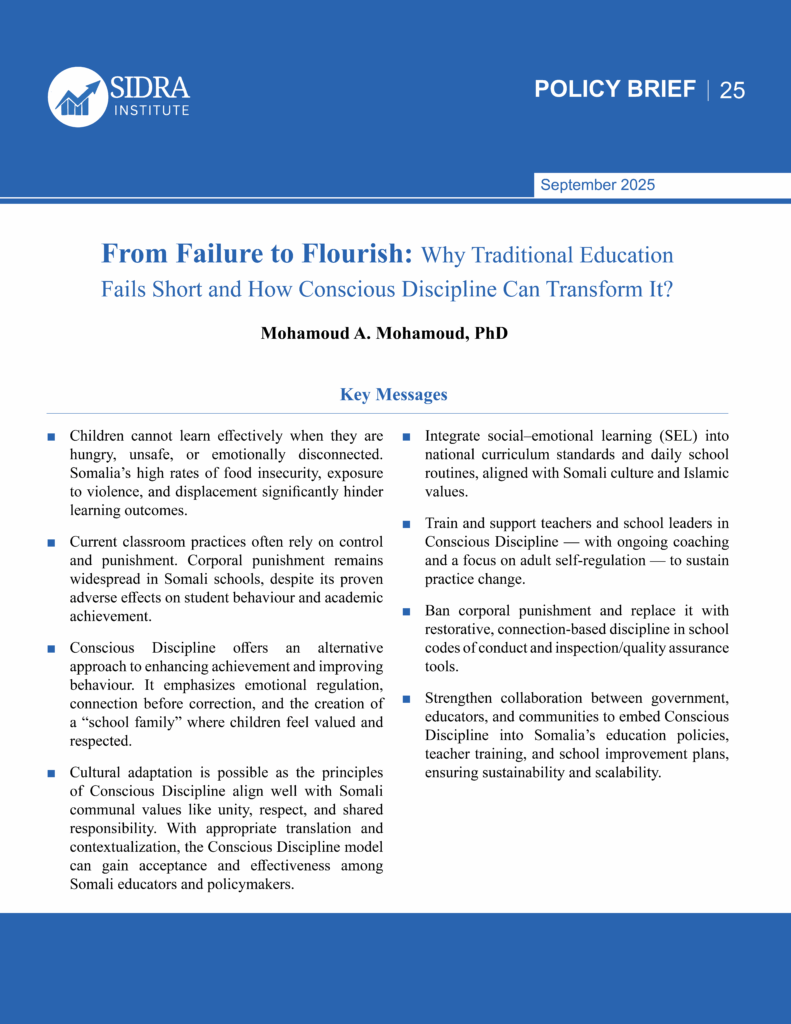
From Failure to Flourish: Why Traditional Education Fails Short and How Conscious Discipline Can Transform It?

This policy brief advocates for the introduction of Conscious Discipline, a trauma-informed, relationship-based approach to behaviour and learning to improve educational outcomes in Somalia. The current reliance on punitive discipline, coupled with high rates of poverty, food insecurity, and trauma, has left millions of children either out of school or unable to learn effectively. Data from UNICEF, the World Bank, and Somali authorities confirm that school attendance, quality of instruction, and emotional safety remain critically low. Conscious Discipline offers a locally adaptable alternative that focuses on building emotional security, connection, and self-regulation in children. The brief outlines recommendations for integrating this approach into national education policy, teacher training, and community engagement. It concludes that creating emotionally safe learning environments is not a luxury but necessary for Somalia to build an inclusive, resilient, and effective education system. Key Findings

From Failure to Flourish: Why Traditional Education Fails Short and How Conscious Discipline Can Transform It? Read More »

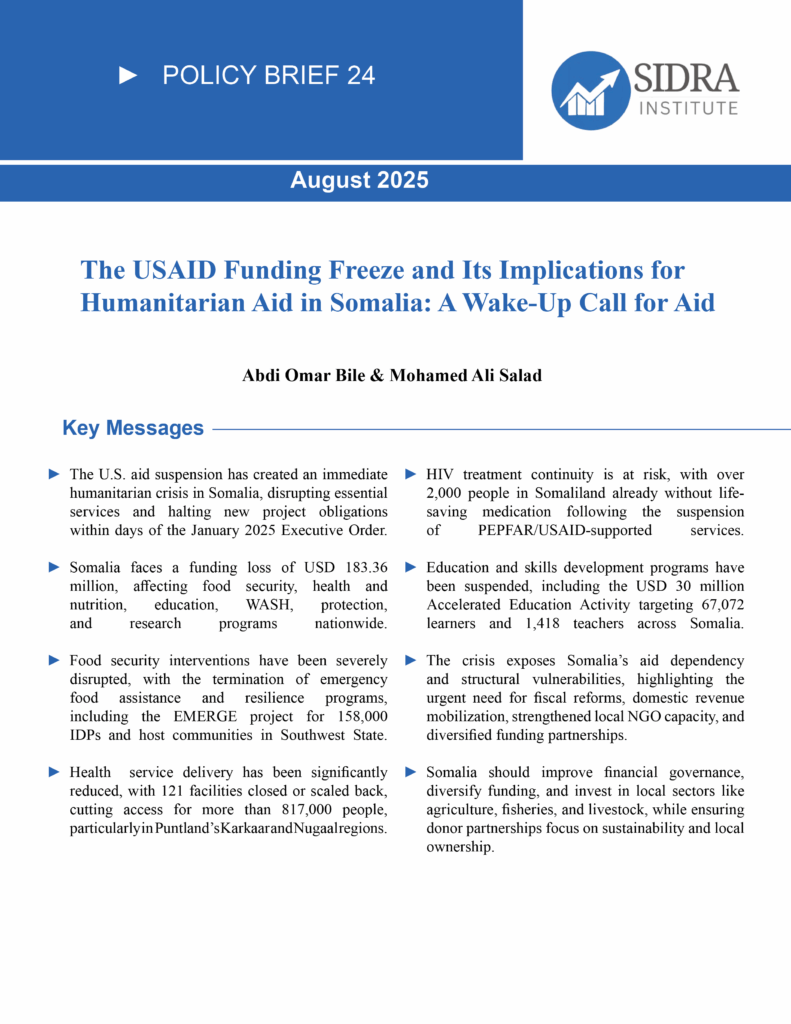
The USAID Funding Freeze and Its Implications for Humanitarian Aid in Somalia: A Wake-Up Call for Aid Dependency

On January 20, 2025, US President Donald Trump issued an Executive Order (EO) mandating a 90-day suspension of U.S.-funded foreign aid, including humanitarian operations, with the stated aim of evaluating the alignment of US foreign development assistance with the administration’s foreign policy priorities (White House, 2025). On January 24, 2025, the United States Agency for International Development (USAID), the agency responsible for distributing civilian foreign aid on behalf of the US government, announced to all its global partners a pause on all new funding obligations and sub-obligations under Development Objective Agreements (DOAGs) (USAID, 2025) The United States is the world’s largest donor of international aid. Established in 1961, USAID serves as the US government’s primary agency for funding international development and humanitarian assistance and is globally recognized for its leadership in delivering growth and humanitarian aid (FY 2024 International Affairs Budget, n.d.). Several government agencies are involved in US foreign assistance, with USAID accounting for approximately 60% of the total, followed by the Department of State, which manages nearly 30% (Brookings, 2024). In fiscal year 2024, the United States allocated $54 billion in global assistance, supporting various international programs. Of this amount, $13 billion was explicitly directed to sub-Saharan Africa, addressing critical needs such as humanitarian aid, economic development, and infrastructure projects. Additionally, a significant portion of the remaining funds was invested in global programs, including health initiatives to combat diseases and improve medical access and climate-related efforts crucial for achieving environmental protection and sustainability. Africa has become a primary beneficiary of these broader programs, receiving substantial support to enhance resilience and development (Foreign Assistance, 2024). The suspension of US Government funding, particularly through USAID, caused widespread disruption in ongoing and planned humanitarian programs, such as health and nutrition programs, which are critical for the health, welfare, and livelihoods of vulnerable communities worldwide. The disruption has affected millions of people, particularly in vulnerable and crisis-affected regions in the world, by cutting off essential services such as HIV treatment, tuberculosis care, and food aid (New York Times, 2025). Africa has been significantly impacted by the suspension of USAID funding, where many countries depend heavily on USAID for essential programs, with healthcare being the most significant component of US aid to Africa (ISSAfrica, 2025). Somalia, a Horn of Africa nation facing challenges such as conflict, drought, and economic instability, relies heavily on aid. USAID funding has been a crucial lifeline, supporting essential areas such as food security, healthcare, education, and governance. The United States has provided nearly $2.3 billion for humanitarian assistance in Somalia since Fiscal Year 2022, supporting programs ranging from emergency nutrition and sanitation projects to education, skills, and livelihood programs (Reliefweb, 2024). In 2025, Somalia was set to receive $125 million in USAID funding for similar programs (AP, 2025). A recent survey by the Somali NGO Consortium on the impact of the US aid suspension in Somalia revealed significant disruptions to humanitarian efforts. Hundreds of NGO staff have been affected, and millions have been left without essential services. According to the survey, over 60% of NGOs operating in Somalia counted on USAID as their leading donor to address humanitarian needs. Approximately 70% of national and international NGOs in Somalia receive funding from the Bureau for Humanitarian Assistance (BHA) and USAID, with more than half receiving stop-work orders, including those with indirect funding. The most affected sectors are health, nutrition, WASH, food security, education, and protection. Over 10,000 beneficiaries have been directly impacted, with one organization reporting disruptions affecting over 1.6 million people. Staff layoffs and unpaid leave have become common, leaving many NGOs in a state of uncertainty (Somali NGO Consortium, 2025). SIDRA Institute has produced this policy brief against the backdrop of the omnipresent concern about the US funding freeze to highlight its effects on the delivery of essential services for vulnerable communities, the impact on NGO staff and employment, disruptions to economic development, and the broader implications of the sudden withdrawal of assistance in the context of aid dependency.

The USAID Funding Freeze and Its Implications for Humanitarian Aid in Somalia: A Wake-Up Call for Aid Dependency Read More »

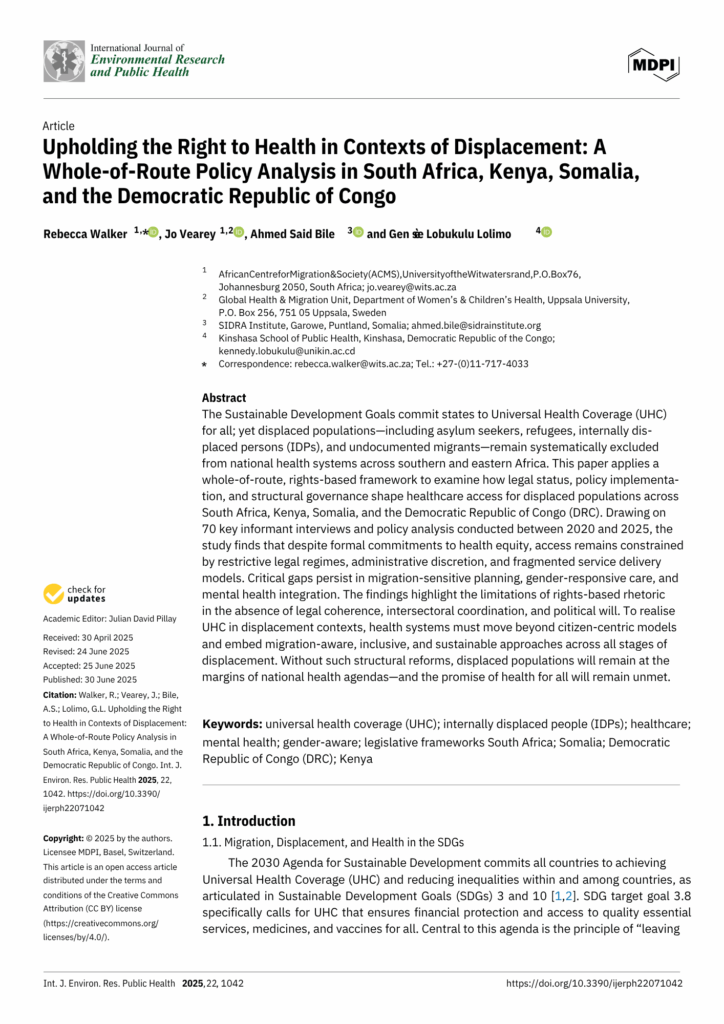
Upholding the Right to Health in Contexts of Displacement: A Whole-of-Route Policy Analysis in South Africa, Kenya, Somalia, and the Democratic Republic of Congo

This Paper was originally published on www.mdpi.com The Sustainable Development Goals commit states to Universal Health Coverage (UHC) for all; yet displaced populations—including asylum seekers, refugees, internally displaced persons (IDPs), and undocumented migrants—remain systematically excluded from national health systems across southern and eastern Africa. This paper applies a whole-of-route, rights-based framework to examine how legal status, policy implementation, and structural governance shape healthcare access for displaced populations across South Africa, Kenya, Somalia, and the Democratic Republic of Congo (DRC). Drawing on 70 key informant interviews and policy analysis conducted between 2020 and 2025, the study finds that despite formal commitments to health equity, access remains constrained by restrictive legal regimes, administrative discretion, and fragmented service delivery models. Critical gaps persist in migration-sensitive planning, gender-responsive care, and mental health integration. The findings highlight the limitations of rights-based rhetoric in the absence of legal coherence, intersectoral coordination, and political will. To realise UHC in displacement contexts, health systems must move beyond citizen-centric models and embed migration-aware, inclusive, and sustainable approaches across all stages of displacement. Without such structural reforms, displaced populations will remain at the margins of national health agendas—and the promise of health for all will remain unmet.

Upholding the Right to Health in Contexts of Displacement: A Whole-of-Route Policy Analysis in South Africa, Kenya, Somalia, and the Democratic Republic of Congo Read More »

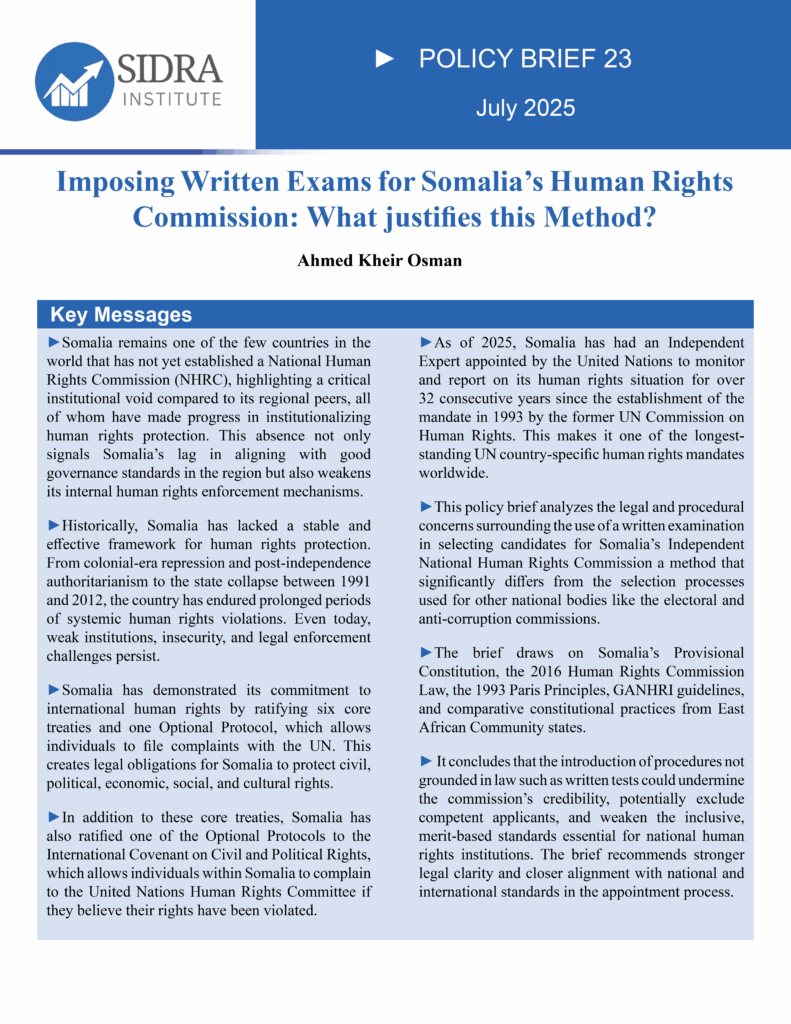
Imposing Written Exams for Somalia’s Human Rights Commission: What justifies this Method?

Somalia remains one of the few countries in the world that has not yet established a National Human Rights Commission (NHRC), highlighting a critical institutional void compared to its regional peers, all of whom have made progress in institutionalizing human rights protection. Historically, Somalia has lacked a stable and effective framework for human rights protection. From colonial-era repression and post-independence authoritarianism to the state collapse between 1991 and 2012, the country has endured prolonged periods of systemic human rights violations. Even today, weak institutions, insecurity, and legal enforcement challenges persist. Conversely, Somalia has shown commitment to international human rights by ratifying six (6) core human rights treaties and one Optional Protocol, allowing individuals to submit complaints to the UN Human Rights Committee. In addition to these core treaties, Somalia has also ratified one of the Optional Protocols to the International Covenant on Civil and Political Rights, which allows individuals within Somalia to complain to the United Nations Human Rights Committee if they believe their rights have been violated. As of 2025, Somalia has had an Independent Expert appointed by the United Nations to monitor and report on its human rights situation for over 32 consecutive years since the establishment of the mandate in 1993 by the former UN Commission on Human Rights. This makes it one of the longest-standing UN country-specific human rights mandates worldwide. This policy brief analyzes the legal and procedural concerns surrounding the use of a written examination in selecting candidates for Somalia’s Independent National Human Rights Commission a method that significantly differs from the selection processes used for other national bodies like the electoral and anti-corruption commissions. The brief draws on Somalia’s Provisional Constitution, the 2016 Human Rights Commission Law, the 1993 Paris Principles, GANHRI guidelines, and comparative constitutional practices from East African Community states.  It concludes that the introduction of procedures not grounded in law such as written tests could undermine the commission’s credibility, potentially exclude competent applicants, and weaken the inclusive, merit-based standards essential for national human rights institutions. The brief recommends stronger legal clarity and closer alignment with national and international standards in the appointment process.

Imposing Written Exams for Somalia’s Human Rights Commission: What justifies this Method? Read More »

Strengthening Somalia’s Mental Health Workforce: A Case Study of Puntland

The global shortage of mental health professionals is particularly severe in countries such as Somalia, revealing the urgent need for innovative solutions. This study investigated the barriers to the mental health workforce development in Puntland, Somalia, focusing on inadequate training programs, financial constraints, and cultural resistance to mental health careers. Using a qualitative research design, Semi-structured interviews were conducted with nine mental health professionals from Puntland, Somalia  using a qualitative research design. The findings revealed severe infrastructure deficiencies, an absence of specialized training programs, and a widespread stigma discouraging entry into the field. Government inaction, underfunding, and cultural misconceptions further limit access to quality mental health services and restrict professional development in this sector. To address these challenges, this study underscores the urgent need for government-led policy reforms, including investment in mental health education, workforce development, and the integration of psychiatric services into Somalia’s broader healthcare system. Additionally, targeted public awareness campaigns are essential for reducing stigma and fostering  cultural acceptance of psychiatric care. Without substantial policy interventions and long-term financial commitments, Somalia’s mental health crisis will persist, leaving vulnerable populations without access to essential resources.

Strengthening Somalia’s Mental Health Workforce: A Case Study of Puntland Read More »

Conceptualizing the Somali Political Crisis: The Way Out of the Current Quagmire

Introduction Somalia is grappling with political and constitutional crises of monumental proportions that is threatening institutional collapse. The constitutional review process has ground to a halt as political squabbles continue to dog the federal system that has become inherently dysfunctional. With just over a year left before the expiration of the mandates of the current Federal Government, and Parliament, Somalia remains at a crossroads due to a paralysis in governance as violent conflicts rage across the country. According to Amanda Frost, a Law Professor at the University of Virginia, a constitutional crisis occurs “when one branch of government, usually the executive, “blatantly, flagrantly and regularly exceeds its constitutional authority — and the other branches are either unable or unwilling to stop it. ¹” The crisis in governance is compounded by the deteriorating security situation and lack of a negotiated settlement that can deliver Somalia from ongoing political doldrums, anarchy and lawlessness.  Conceptual Analyses To better understand Somalia’s ongoing quagmire, presenting in-depth conceptual analyses of the unresolved constitutional crisis can shed light on the current impasse. Relevant theoretical frameworks include the constitutional theory, conflict theory and negotiation theory. Constitutional Theory German Philosopher Emmanuel Kant, is credited with formulating ideas that laid the foundation of the constitutional theory of the twentieth century. A distinctive feature of the Kantian theory is the emphasis on the supremacy of a country’s written constitution arguing that the exercise of government power must be constrained by the law and guided by a social contract as a regulative matter². This doctrine further posits that the “power of the state must be limited in order to protect the citizens from the arbitrary exercise of authority. While the theory supports the ideals for building a universal and permanent peaceful life, its basic premise underlines the necessity for the creation of the most just and fair organization of people’s life under the aegis of the law.” ³ __________________________________________________________________________________________________ ¹ NPR: https://www.npr.org/2025/02/11/1230674436/are-we-in-a-constitutional-crisis ² Immanuel Kant, History of Political Philosophy, edited by Leo Strauss and Joseph Cropsey, University of Chicago Press, Chicago and London, 1987 ³ ibid Based on the above theory, Somalia’s constitutional crisis will remain unresolved unless the recurrent abuse of power by the Executive as well as attempts to mutilate and manipulate the constitution to suit particular political interests at the expense of the national agenda is checked and the necessary safeguards put in place to protect the country’s constitutional gains.  As per the constitutional theory, “the necessity for the creation of the most just and fair organization of people’s life under the aegis of the law” is inherently lacking in Somalia while the quest to build a universal and permanent peaceful life is undermined by Villa Somalia’s rule by decree virtually usurping the powers of the judiciary and legislature and undercutting the independence of the public bureaucracy. The ruling class and all concerned stakeholders must uphold the doctrine of the supremacy of the constitution as the fundamental and paramount law of the land to which the country shall duly be governed. Under this doctrine, if a newly enacted law or contract violates any provisions in the constitution whether in part or whole and whether promulgated by legislative or executive powers, such an enactment shall be deemed as null and void and without any effect or force. Constitutional actors and office holders must adhere to and advance the principles and practices that underpin the constitutional order while conforming to established norms for resolving contested constitutional matters. Conflict Theory Somalia is a country embroiled in a protracted conflict that has overtime, unleashed the dark forces of clannism, warlordism, terrorism and state violence. At the conceptual level, conflict theories assume that all societies have structural power divisions and resource inequalities that lead to groups having conflicting interests. While Karl Marx emphasized class conflict (the bourgeoisie vs. proletariat) over economic resources, Max Weber suggested that conflict and inequality can be caused by power and status independently of class structures. ⁴ The Marxist definition technically applies to industrialized countries where society is organized along two major classes, the bourgeoisie, erstwhile regarded as the owners of means of production and the proletariat, the exploited working class whose labour is the primary source of capital accumulation, wealth and profit for the ruling class. Some conflict analysts argue that the Weberian premise that explores factors beyond class can better explain the myriads of conflicts in non-industrialized countries, Somalia included. Scholars like Alex De Waal have rejected the notion that Somalia has fractured along clan lines, because of the inherent incapacity of the clan system of politics to provide the basis for a modern state. De Waal argues that even in a country without a functioning government and formal economy, control over productive resources and the means of trade are the core to the political economy⁵. __________________________________________________________________________________________ ⁴ What is Conflict Theory: https://www.simplypsychology.org/conflict-theory.html He highlights the nature of the resource-driven Somali conflict that is rooted in riverine agricultural land, pastureland, remittances from overseas workers and the resources that can be captured and dispensed by a sovereign state, including foreign aid and currency (“sovereign rents”). Further, De Waal has developed a class analysis of the origins and development of the crisis, locating it in “the growth of state-mediated capitalist relations in both agriculture and pastoralism, and the key role that control of the state apparatus played in allowing capital accumulation among certain sections of the mercantile class in the 1980’s⁶.” More importantly, De Waal points to the “legacy of disputed ownership of real estate and agricultural land as one key element in the enduring crisis”, adding “the expectation that a future government will be able to bestow the same benefits on its favoured businessmen is a key element in sharpening the ongoing struggle in southern Somalia.⁷” In finding a lasting resolution, both the class and clan dynamics of the Somali conflict as well as the rent seeking by state and private sector actors must be addressed. As a step forward, peacebuilders and mediators need to acknowledge the often

Conceptualizing the Somali Political Crisis: The Way Out of the Current Quagmire Read More »

The Impact of a Knowledge-Based Economy on Nation-Rebuilding: A Case Study of Somalia

The transition to a knowledge-based economy (KBE) in Somalia faces significant challenges, including political instability, weak governance, inadequate infrastructure, and limited investment in education and technology. This study examines how the KBE can contribute to nation building by enhancing governance, fostering economic diversification, promoting social cohesion, and strengthening institutional capacity. Using a qualitative case study approach, this research draws on secondary data and stakeholder interviews to explore the relationship between KBE elements and Somalia’s reconstruction efforts. The findings reveal that the KBE enhances governance through ICT-driven e-governance, improving transparency, and service delivery. It also promotes economic diversification, with sectors such as telecommunications and mobile banking reducing their reliance on traditional industries. Education in science, technology, engineering, and mathematics( STEM) fields fosters social cohesion and national identity, whereas the Somali diaspora plays a pivotal role in capacity building through knowledge transfer and innovation. The study recommends prioritizing Research and Development (R&D) to drive innovation and entrepreneurship, strengthening STEM education to equip citizens with critical skills, and integrating Information and Communication Technology (ICT) in governance to improve efficiency. Engaging the Somali diaspora in capacity-building initiatives is crucial for sustainable development and offers a pathway to a resilient and unified nation.

The Impact of a Knowledge-Based Economy on Nation-Rebuilding: A Case Study of Somalia Read More »

Bridging Gaps in Healthcare: The Case for a Tertiary Hospital in Puntland

The healthcare challenges in Somalia are immense. The public healthcare sector struggles with limited resources and depends heavily on external donor support. The private healthcare, while growing, is unregulated and unable to meet the needs of a population seeking care for acute, chronic and complex health conditions. SIDRA Institute sought to examine the enabling and disabling factors of establishing a state-of-the-art private hospital in Puntland State, Somalia. This research employed a mixed-methods approach, including secondary data analysis, surveys with 106 participants through snowball sampling, and 12 key informant interviews with healthcare practitioners and policymakers. The study mapped the healthcare landscape in Puntland, which is characterized by a fragile public health system and an under-regulated private sector, alongside a growing reliance on costly medical tourism for specialized care. The study found critical deficiencies in healthcare infrastructure and service delivery, particularly in managing chronic and complex medical conditions. Approximately 31% of surveyed patients reported the unavailability of services locally, while 41% expressed dissatisfaction with the quality of care as a primary motivators for seeking treatment abroad. The economic implications are profound with the average cost of medical tourism exceeding $8,500 per patient. The study further highlights inadequacies in diagnostic capabilities and specialized healthcare personnel in Puntland State, underscoring systemic barriers to dissatisfaction and utilization of healthcare. This study proposes the establishment of a private hospital which can bring modern, specialized medical services closer to home, offering an alternative to the costly and emotionally taxing journey abroad with special focus on workforce development, improvement of regulations, and ensuring reliable medical supplies. The study concludes that a modern, private hospital has the potential to transform healthcare access and quality in Puntland State, an objective which is aligned with Somalia’s Health Sector Strategic Policy (HSSP II).

Bridging Gaps in Healthcare: The Case for a Tertiary Hospital in Puntland Read More »

Scroll to Top