
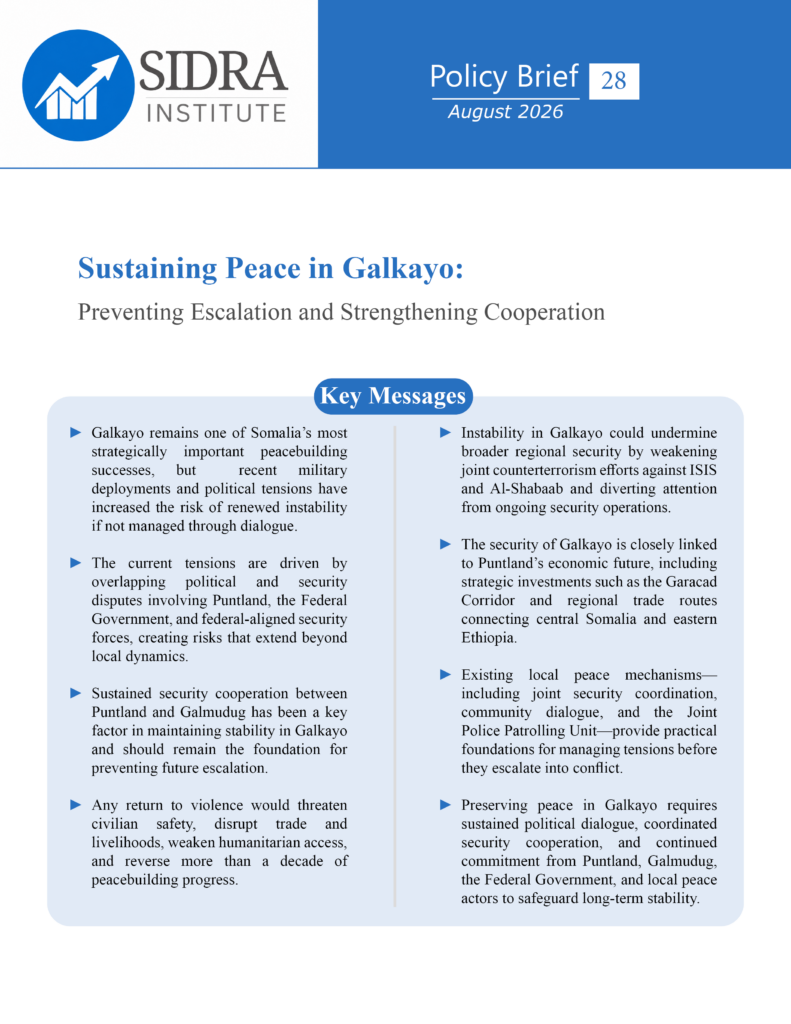
Sustaining Peace in Galkayo: Preventing Escalation and Strengthening Cooperation
Galkayo is a town in the Mudug region of central Somalia. It is a border town divided into northern and southern sections under the 1993 Mudug Peace Agreement. The city’s division dates back to the collapse of the Somali military government led by General Mohamed Siad Barre in 1991, which plunged the country into clan-based conflict. Today, North Galkayo is administered by Puntland, established in 1998, while South Galkayo is administered by Galmudug, established in 2006. During the civil war, Galkayo became one of Somalia’s major conflict hotspots, witnessing intense fighting between the Somali Salvation Democratic Front (SSDF) and the Somali National Democratic Union (SNDU) on one side, and the United Somali Congress (USC) on the other. On 4 June 1993, SSDF leader Abdullahi Yusuf Ahmed, SNDU leader Ali Ismail Abdi-Giir, and USC Chairman General Mohamed Farah Aideed signed the Mudug Peace Agreement, ending major hostilities in the region and establishing a framework for coexistence that has continued to shape Galkayo’s political and administrative landscape. Following the Mudug Peace Agreement, Galkayo experienced nearly two decades of relative stability, with no major armed confrontations until November 2015, when fighting erupted between Puntland and Galmudug forces. The conflict, which continued until December 2015, left at least 20 people dead and more than 120 others injured. It also displaced over 90,000 residents (Heritage Institute, 2016). This highlights the city’s continued vulnerability to renewed violence despite years of relative peace. Similarly, less than a year later, Puntland and Galmudug were again engaged in deadly fighting in Galkayo in October 2016 over a disputed border area. The violence erupted on the outskirts of the city at the site of a livestock market under construction by the Puntland administration. Humanitarian agencies estimated that nearly 90,000 people were displaced by the conflict, while dozens of people, mainly from the warring parties, were killed (ReliefWeb, 2016). In December 2017, the leaders of Puntland and Galmudug reached a peace agreement facilitated by the Federal Government of Somalia and international partners (Goobjoog, 2017). The agreement established a ceasefire, promoted cooperation between the two administrations, facilitated the reopening of roads and commercial activities, and created mechanisms for dialogue and joint security coordination. In the years that followed, Puntland and Galmudug continued to strengthen cooperation to maintain stability in the Mudug region, particularly in Galkayo. Successive leaders from both administrations reaffirmed their commitment to implementing previously signed agreements through regular dialogue and confidence-building measures. In 2020, Puntland and Galmudug reached a new agreement to cooperate on security, institution-building, and economic development (Puntland Post, 2020). One of the most notable outcomes of this cooperation has been joint counterterrorism efforts, which have enabled the security authorities of both administrations to coordinate operations against common security threats. Against this backdrop, this policy brief examines recent security developments in Galkayo, assesses the potential risks associated with renewed tensions, and analyzes their implications for peace, civilian protection, and regional stability. It also identifies the key drivers of the current security dynamics and proposes evidence-based policy options to prevent further escalation, strengthen dialogue and security coordination, and preserve the hard-won stability achieved in Galkayo over the past decade.
Sustaining Peace in Galkayo: Preventing Escalation and Strengthening Cooperation Read More »