
SIDRA Institute

July 2025

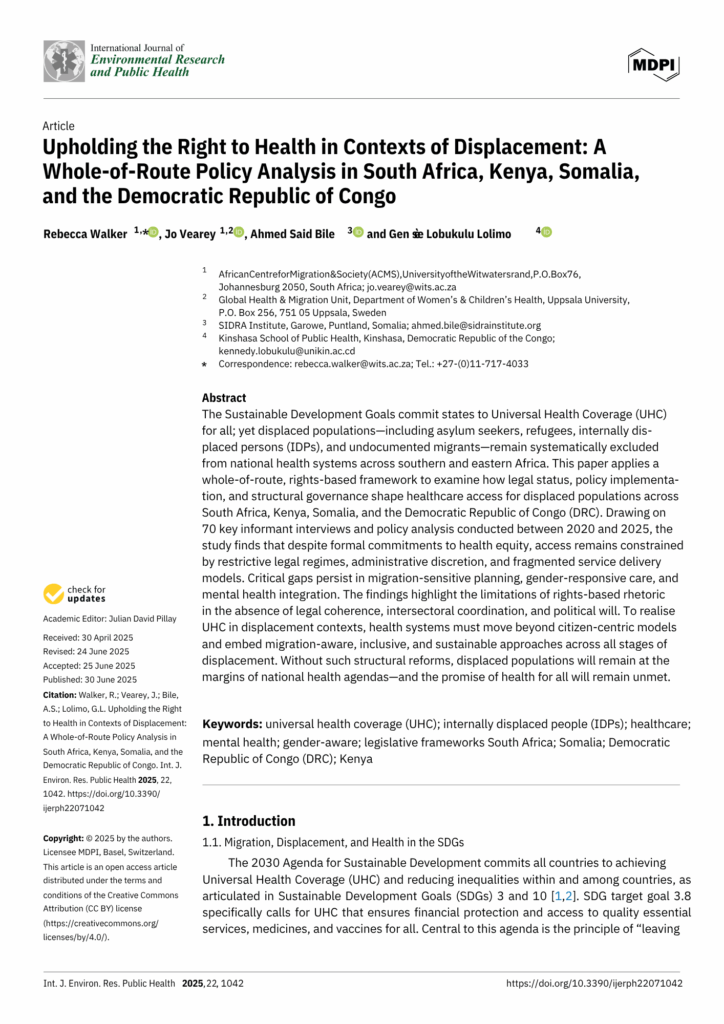
Upholding the Right to Health in Contexts of Displacement: A Whole-of-Route Policy Analysis in South Africa, Kenya, Somalia, and the Democratic Republic of Congo

This Paper was originally published on www.mdpi.com The Sustainable Development Goals commit states to Universal Health Coverage (UHC) for all; yet displaced populations—including asylum seekers, refugees, internally displaced persons (IDPs), and undocumented migrants—remain systematically excluded from national health systems across southern and eastern Africa. This paper applies a whole-of-route, rights-based framework to examine how legal status, policy implementation, and structural governance shape healthcare access for displaced populations across South Africa, Kenya, Somalia, and the Democratic Republic of Congo (DRC). Drawing on 70 key informant interviews and policy analysis conducted between 2020 and 2025, the study finds that despite formal commitments to health equity, access remains constrained by restrictive legal regimes, administrative discretion, and fragmented service delivery models. Critical gaps persist in migration-sensitive planning, gender-responsive care, and mental health integration. The findings highlight the limitations of rights-based rhetoric in the absence of legal coherence, intersectoral coordination, and political will. To realise UHC in displacement contexts, health systems must move beyond citizen-centric models and embed migration-aware, inclusive, and sustainable approaches across all stages of displacement. Without such structural reforms, displaced populations will remain at the margins of national health agendas—and the promise of health for all will remain unmet.
Upholding the Right to Health in Contexts of Displacement: A Whole-of-Route Policy Analysis in South Africa, Kenya, Somalia, and the Democratic Republic of Congo Read More »

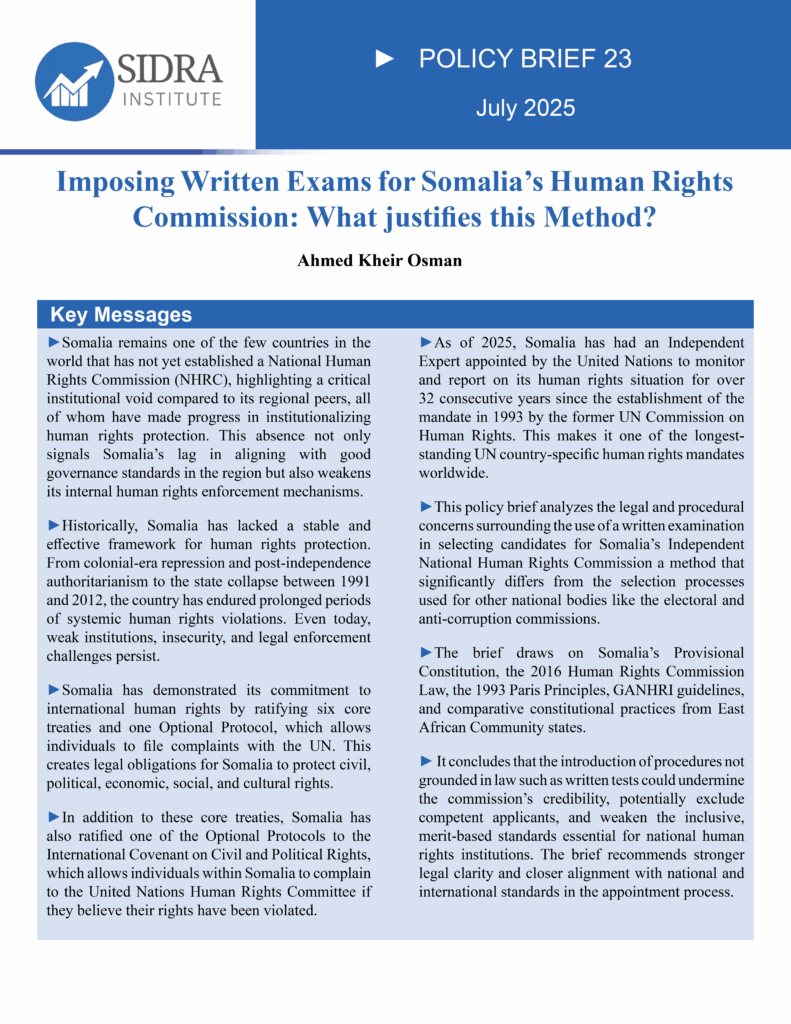
Imposing Written Exams for Somalia’s Human Rights Commission: What justifies this Method?

Somalia remains one of the few countries in the world that has not yet established a National Human Rights Commission (NHRC), highlighting a critical institutional void compared to its regional peers, all of whom have made progress in institutionalizing human rights protection. Historically, Somalia has lacked a stable and effective framework for human rights protection. From colonial-era repression and post-independence authoritarianism to the state collapse between 1991 and 2012, the country has endured prolonged periods of systemic human rights violations. Even today, weak institutions, insecurity, and legal enforcement challenges persist. Conversely, Somalia has shown commitment to international human rights by ratifying six (6) core human rights treaties and one Optional Protocol, allowing individuals to submit complaints to the UN Human Rights Committee. In addition to these core treaties, Somalia has also ratified one of the Optional Protocols to the International Covenant on Civil and Political Rights, which allows individuals within Somalia to complain to the United Nations Human Rights Committee if they believe their rights have been violated. As of 2025, Somalia has had an Independent Expert appointed by the United Nations to monitor and report on its human rights situation for over 32 consecutive years since the establishment of the mandate in 1993 by the former UN Commission on Human Rights. This makes it one of the longest-standing UN country-specific human rights mandates worldwide. This policy brief analyzes the legal and procedural concerns surrounding the use of a written examination in selecting candidates for Somalia’s Independent National Human Rights Commission a method that significantly differs from the selection processes used for other national bodies like the electoral and anti-corruption commissions. The brief draws on Somalia’s Provisional Constitution, the 2016 Human Rights Commission Law, the 1993 Paris Principles, GANHRI guidelines, and comparative constitutional practices from East African Community states.  It concludes that the introduction of procedures not grounded in law such as written tests could undermine the commission’s credibility, potentially exclude competent applicants, and weaken the inclusive, merit-based standards essential for national human rights institutions. The brief recommends stronger legal clarity and closer alignment with national and international standards in the appointment process.

Imposing Written Exams for Somalia’s Human Rights Commission: What justifies this Method? Read More »

Scroll to Top